So you’ve let it cool. You’ve given yourself some distance. And now your draft is waiting.
You know you need to read it. But something about actually opening that document feels a little like opening a time capsule you’re not sure you want to see inside. What if it’s worse than you remembered? What if you can’t see how to fix it? What if you read the whole thing and just feel lost?
Here’s the deal. How you mentally approach this next step matters as much as what you find. The writers who spiral during revision usually aren’t spiraling because the draft is bad. They’re spiraling because they came in without a plan.
So let’s give you a plan.
First, Change Your Job Title
When you wrote the draft, you were the writer. Your job was to create — to keep moving, trust your instincts, and fill the pages.
For this first read, your job is different. You’re not the writer anymore. You’re the reader.
That might sound like a small shift, but it not. A reader doesn’t line-edit. A reader doesn’t stop to fix clunky sentences or reorganize chapters on the fly. A reader follows the story and pays attention to how it feels.
That’s the only job you have right now. Read the story. Feel it. Notice it.
Not fix it. Not judge it. Not compare it to the book you imagined writing. Just read it like someone who genuinely wants to know what happens.
Set Yourself Up to Actually Do This
A few practical things that make a real difference:
Print it if you can.
Reading on screen keeps you in “writer mode” — your cursor blinks, the urge to edit is one click away, and your brain stays in fix-it mode. Printing creates distance. It makes the manuscript feel like someone else’s work, which is exactly the feeling you’re after.
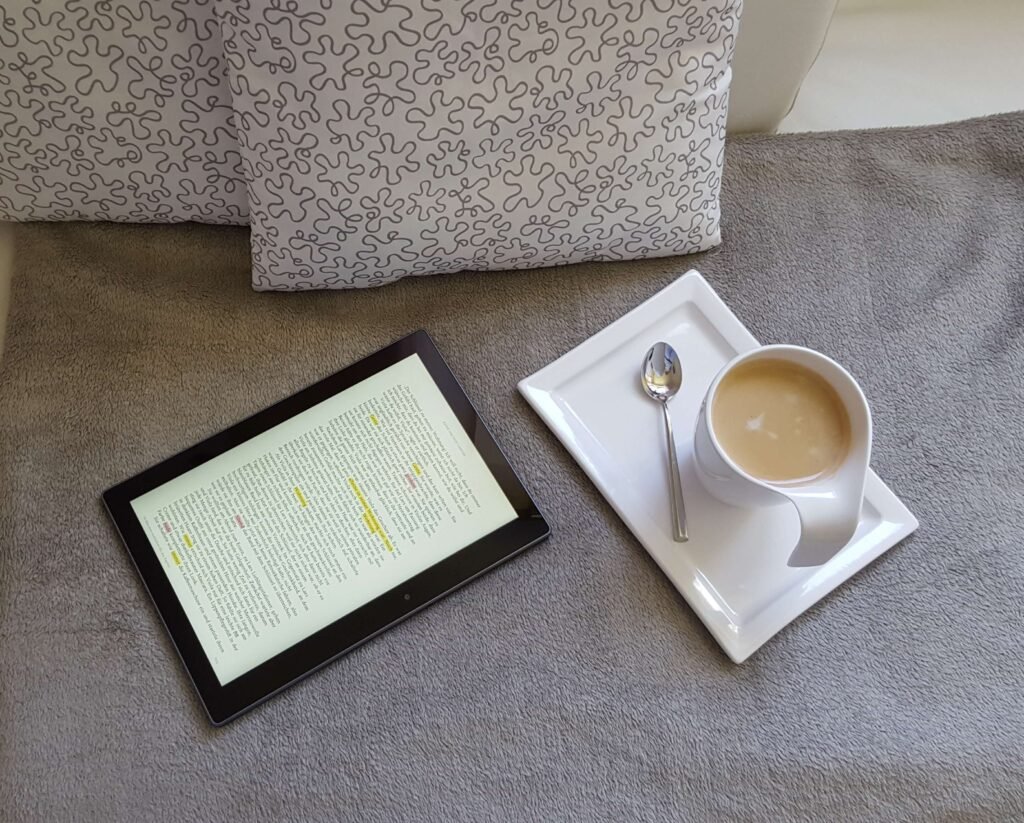
If printing isn’t an option, try reading in a different format: export to a PDF or send it to a Kindle or e-reader. Anything that gets it out of your usual writing environment helps.
Bring a pen, not a keyboard.
Your only tool on this first pass is a pen or pencil. You’re making notes and circling things, not rewriting. The moment you open your laptop to fix something mid-read, you’ve slipped back into writer mode, and you’ll lose the experience of feeling the whole story.
Read in longer stretches.
Short, scattered reading sessions are hard on this kind of work. You lose the rhythm of the story, you can’t feel pacing issues, and every time you sit back down you have to re-orient yourself. If you can carve out a few longer blocks such as an hour, two hours, or a Saturday morning, the read goes better. You start to experience the manuscript the way a reader would.
Don’t time this with a bad week.
If you’re exhausted, stressed, or already running on empty, this is not the week to sit down with your draft for the first time. Your inner critic is loudest when you’re depleted. Give yourself the best conditions you can. Your draft deserves a fair read, and so do you.
What to Pay Attention To
On this first pass, you’re not looking for typos. You’re not hunting for plot holes to solve. You’re reading for feeling. Here’s a simple set of signals to watch for:
Where does the story pull you forward?
Notice the scenes where you forget you’re the one who wrote it, where you genuinely want to know what happens next, or where a character does something that surprises even you. Mark those moments. That’s the pulse of your story. Those sections are alive, and they’ll anchor your revision.
Where do you slow down or drift?
Notice the places where you find yourself skimming, or re-reading the same paragraph because your mind wandered, or where the story feels like it’s spinning its wheels. You don’t need to know how to fix it yet. Just put a question mark in the margin and keep going.
Where do you feel confused?
If you, the person who wrote this, find yourself uncertain about what’s happening or why a character made a choice, flag that section. A reader who didn’t write it won’t have more context than you do. Note it and move on.
Where does something feel off, even if you can’t name it?
Trust that feeling. You don’t need a diagnosis during the first read. “Something’s not right here” is enough. Put a star, a circle, a question mark, whatever your system is, and keep reading. You’ll have time to figure out what’s off later.
What Not to Do
I want to be direct about this because it’s where most writers derail:
Do not stop to rewrite. Not a sentence, not a paragraph, not even a word. If you catch yourself fixing something mid-read, stop. Make a note in the margin and move on. The rewriting comes later. Right now you need to see the whole story, and you can’t do that if you’re stuck on page 47.
Do not decide it’s broken. One first read is not a verdict. You are gathering information, not issuing a judgment. Whatever you find is fixable: the big gaps, thin characters, an ending that doesn’t land. All of them. But you can’t know what actually needs fixing until you’ve seen the whole picture.
Do not compare it to published books. Your draft was written under completely different conditions than any finished novel on your shelf. Those books went through months or years of revision. Your draft just came out of the ground. Of course it looks different. That’s not a problem. That’s just where you are in the process.
After the Read: The Simple Debrief
When you finish the full first read, and I mean finish, don’t stop in the middle to do this, I want you to spend about fifteen minutes with these four questions. Write your answers down.
What is this story actually about? (Not the plot — the heart of it.)
What’s working? What felt alive?
What’s the biggest thing that isn’t working yet?
What surprised me?
That last one matters more than you might think. The surprises in the scenes or moments that were better than you remembered, the characters who showed up more fully than you planned are gifts. Your subconscious was working while you wrote. Now you get to see what it made.
Hold onto that debrief. It becomes your map for everything that comes next.
You’re Still a Writer. Even After Reading This.
I won’t sugarcoat it: the first read can be humbling. You may find things that surprise you in both directions. Some of it will be better than you feared. Some of it will need more work than you hoped.
Both of those things can be true at the same time. And both of them are okay.
What matters is that you finish the read. You gather the information. You are not meant to fix everything today, but to understand what you’ve built.
What I’ve come to learn is that writers who finish their revisions aren’t the ones with the cleanest first drafts. They’re the ones who looked at the draft clearly, made a plan, and kept going.
Next week, we’ll talk about that plan — the five things every draft needs before you revise a single scene. For now, go read your story.
Until next week,
Page by Page Studio